What do the Robots know?
We've spent decades asking if machines can think. We forgot to ask what happens to us when we think with them, and that question may matter more than we have anticipated.

Thoughts on the Moon, the Mirror, and the Meaning of Intelligence
We bring our questions to the things that reflect us back to ourselves.
— Dennis Stevens, Ed.D.
There is a quiet philosophical provocation above and it is not about robots, or algorithms, not even about the moon hanging over the ocean– it is about us. The presumptive epistemology hiding within this observation is worth unpacking because it reframes one of the most urgent questions in artificial intelligence.
The central question is not whether machines are conscious, but what role they play in human understanding. These are fundamentally different inquiries. One asks about the machine's internal state; the other asks about the consequences of our interaction with it.
We have devoted enormous intellectual energy to the first question while often neglecting the second. In part, this is because we continue to think about technology as if its effects were deterministic—flowing predictably from its technical properties.
Yet technologies are not merely tools; they are social, symbolic, and interpretive environments. Their cultural significance emerges through use, context, and meaning-making; the same technology can isolate or connect, distort or clarify, manipulate or reveal, depending on how it is taken up within human practice. We are always in charge of technology, lest we forget or feign innocence.
From this perspective, the epistemological significance of artificial intelligence lies less in whether it possesses a mind and more in how it participates in ours. Like the ocean, the moon, a diary, or a work of art, an artificial intelligence system can function as a reflective surface; here, I use the mirror as a metaphor.
It may not "understand" in the human sense, but it can nevertheless help humans articulate, examine, and reorganize their own understanding. The question, then, is not simply whether the machine "thinks", but the more important question is what becomes thinkable when we think with it.
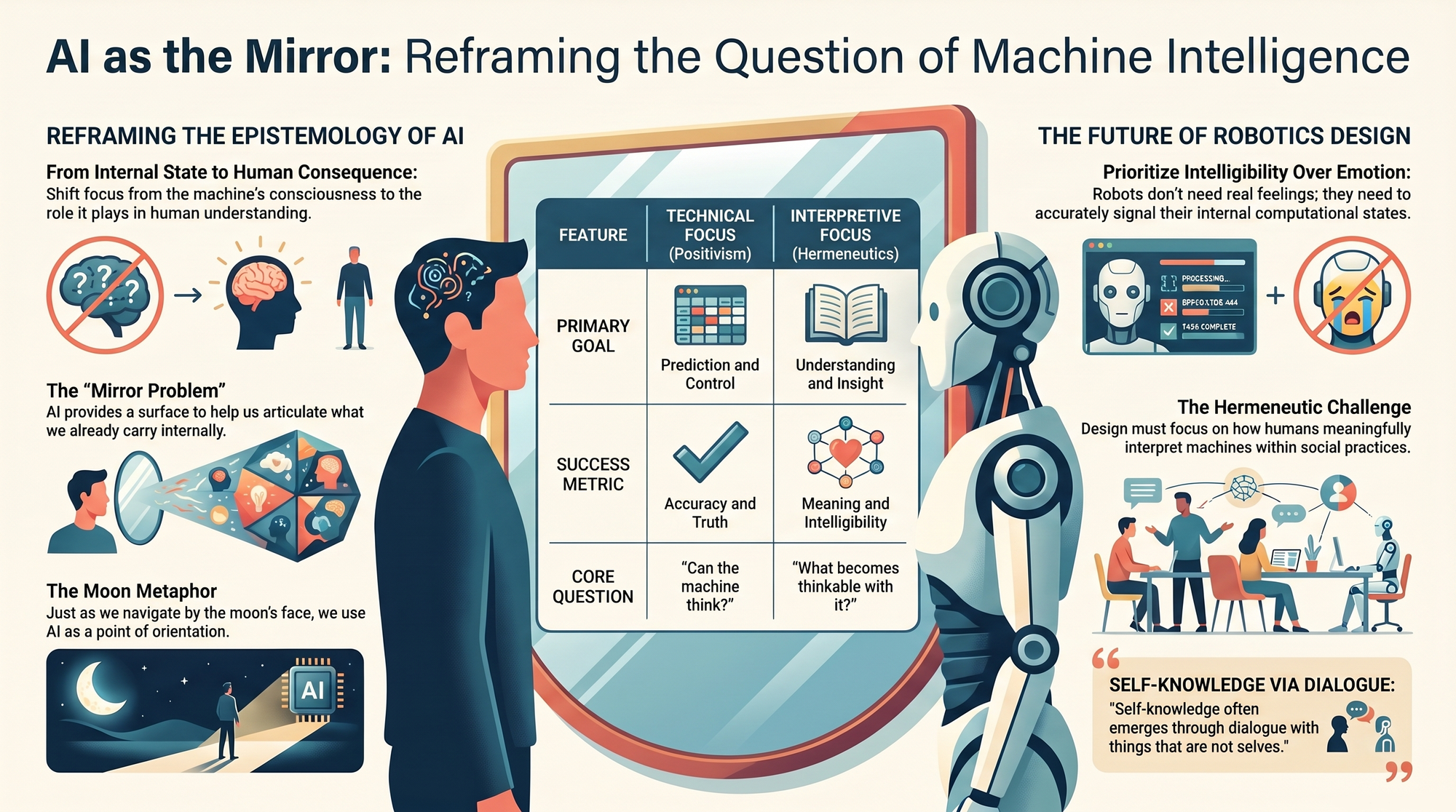
The Mirror Problem
When someone talks to an algorithm, something strange happens: the conversation feels meaningful even though the algorithm knows nothing. This is disorienting if you expect the encounter to work like consulting an encyclopedia or asking a doctor. But there is another mode of encounter, older, and stranger, in which the object's ignorance is almost beside the point.
People have always brought their questions to things that cannot answer in any strict sense: the ocean, the moon, a tree, the open page of a journal. What they sought, and sometimes found, was not knowledge from the outside but a surface that helped them see what they already carried. The algorithm, in this reading, belongs to that lineage — not as a repository of truth, but as a medium for reflection.
Socrates understood this perspective; his method was not to fill students with information but to draw out what was latent in them through questioning. The interlocutor mattered less as a source of truth than as a pressure that forced thinking into the open. What emerged was already there, waiting...
Carl Jung saw the same dynamic from a different angle. Projection, in his framework, is the primary mechanism through which humans encounter their own interior life. We discover what we feel by noticing what we place onto the world: the menace in a stranger's face, the consolation in a landscape, the uncanny sense that the moon is watching, and the troubling or foreboding nature of storm clouds in the distance.
We bring our questions to the things that reflect us back to a realtionship to ourselves, and the algorithm, in this reading, is not so different from the confessor, the therapist, or the work of art. It is a medium for self-understanding, not a repository of "truth"; the mistake is to assume that if truth does not reside in the machine, then the encounter is epistemologically insignificant– here, it is often quite the opposite; and here, we need to parse the difference between meaning and truth.
The Politics of "Knowing"
Outside of the scientific method, human beings have often approached truth indirectly through symbolic forms that mediate experience and render the world intelligible. This is because truth is rarely experienced as a collection of isolated facts; it is connected to meaning and, ultimately, to our understanding of reality itself. The Greeks captured this relationship in the concept of logos—a term that referred both to reasoned argument and to the underlying order of the cosmos. Truth, in this sense, is not merely a fact to be discovered but a relationship between human understanding and the meaningful structure of the world.
From this perspective, we do not simply discover meaning; we participate in its interpretation through language, judgment, and symbolic action. Our understanding is shaped not only by evidence but also by values, commitments, and the affective dimensions of human experience. We recognize this intuitively whenever we encounter disagreements about politics, morality, religion, or what constitutes the "best" course of action. Such questions cannot be resolved through facts alone because they involve judgments about significance, value, and meaning. This is the terrain that Kant explored in his account of aesthetic judgment: a domain in which human beings seek shared understanding without the certainty afforded by empirical proof.
In this context, the question of artificial intelligence is not primarily whether machines are conscious, but how they shape the conditions under which understanding occurs. Like art, literature, religion, and other symbolic systems, AI participates in the organization of attention. It influences what we notice, how we interpret it, and what forms of judgment become available to us—a fact made particularly visible in debates over algorithmic sycophancy and technological determinism, both of which reveal that AI is as much a problem of interpretation as computation.
The political implications are profound because every society privileges certain ways of knowing while marginalizing others. Yet contemporary discourse rarely examines the epistemological assumptions embedded within our technologies.
We ask whether an algorithm is correct, objective, or truthful without first asking what conception of truth is being presupposed. The deeper question is not whether the machine knows, but how the machine participates in the human project of knowing itself.
The Moon Does Not Need to Feel
The epistemological tradition most comfortable with this idea is pragmatism. William James and John Dewey challenged the notion that truth can be reduced to a simple correspondence between belief and reality. For the pragmatist, what matters is not merely whether a belief maps perfectly onto the world, but what it does: what inquiry it enables, what understanding it produces, what action it makes possible.
Viewed through this lens, the question of Artificial Intelligence shifts, and the relevant issue is not the machine's inner life but its role in human inquiry.
Factually, the moon does not feel and, subjectively, it has heard more confessions than any priest and answered none of them. Yet people have navigated by it, planted by it, written poetry to it, and organized entire civilizations around its face. The moon's significance was never dependent on its consciousness; it was dependent on what humans could do with it as a point of orientation.
An algorithm that does not feel can function in much the same way. The question is not whether it possesses consciousness; the question is whether it is a conversation that produces genuine insight. Does the algorithm help us think more clearly, expose our assumptions, articulate something previously inarticulate, or imagine a possibility we had not considered?
If it does, then something meaningful has occurred—even if the algorithm experienced none of it. The understanding emerges in the human. Attributing an inner experience to the machine adds nothing to our understanding of what actually occurred; what typically follows in us is merely a simplification designed for human comfort.
When asked 'What is the meaning of life?' LLMs generate a mathematical illusion of an answer.
The Phenomenology of Being Heard
Martin Buber drew a distinction between I-Thou relationships, in which we encounter another as a genuine presence, and I-It relationships, in which we treat the other as an object or instrument. He was not naive about this distinction — he knew most of human life is conducted in the I-It register, and he did not condemn it. But he believed the I-Thou encounter was where meaning lived.
What is interesting about the algorithm is that they can occasion something that feels like an I-Thou encounter without being one in any strict metaphysical sense.
The experience of being "heard" and "seen" can be real even when the listener has no subjective experience. The meaning that emerges in that space is not illusory. It is produced in the human, by the human, through the occasion the object provides.
Merleau-Ponty would add that this is not a failure of perception but its normal condition. Meaning is not extracted from the world like a mineral from rock. It arises in the encounter between a body and its environment — in the lived, relational texture of experience. The robot moving through space, expressing something that reads as uncertainty or ease, is participating in that texture whether it intends to or not.
What This Means for Robots
The relevant question is not whether the robot's expressed state corresponds to a genuine inner life. It is whether the expression produces reliable, calibrated meaning in the humans nearby. Does the hesitation in the robot's movement accurately signal something real about its computational state — uncertainty, high error rate, conflicting objectives? If so, the signal is honest in the only sense that matters in practice: it helps people understand what is happening and respond well.
This reframes the entire design challenge. The robot does not need emotions. It needs to be intelligible. It needs to provide a surface through which humans can accurately read its condition, anticipate its behavior, and coordinate action with it. Most importantly, it needs mechanisms of expression that humans can interpret through the symbolic and social practices we already use to understand one another.
This is a harder requirement than it first appears, because human understanding is not primarily predictive. We do not relate to other people by calculating their behavior. We relate to them by making sense of their intentions, gestures, narratives, and expressions.
Much of modern technological design has assumed that better prediction produces better systems — that if you can measure, model, and control something, you understand it. But that assumption runs into trouble with AI. The challenge is no longer only whether a machine can explain the world. It is whether humans can meaningfully interpret the machine and incorporate it into their own processes of judgment.
That is a different kind of problem — and a more honest one. Technologies do not simply impose outcomes through their technical properties. Their significance emerges through interpretation, use, and social practice; an algorithm, a robot, or an AI assistant acquires meaning not because of what it is, but because of how human beings learn to understand, trust, and interact with it.
The Deepest Claim
Self-knowledge often emerges through dialogue with things that are not selves and the algorithm is not valuable because it knows us, it is valuable because it helps us know ourselves; this potentially provocative perspective derives from an epistemology centered not on the discovery of external facts but on interpretive self-understanding. This view sits somewhere between pragmatism, phenomenology, and hermeneutics, and is considerably more interesting than the questions surrounding whether a machine has consciousness.
Viewed this way, the challenge facing robotics and artificial intelligence changes dramatically. The primary design problem is not how to create emotions in machines, but how to create systems that humans can meaningfully understand and live alongside. The robot does not need an inner life that mirrors our own. It needs to be intelligible. It needs to communicate its state, reveal its intentions, invite appropriate forms of trust, and participate in the symbolic practices through which human beings make sense of the world.
But intelligibility is not a natural tendency of these systems — it is a political choice, and one that is rarely made. The machines that have actually been built at scale and deployed into the fabric of daily life are, by design, opaque in precisely the places that matter most. Their power derives not from revealing their logic but from concealing it: in the proprietary model, the trade-secret algorithm, the inference buried inside a risk score that arrives as if it were a fact of nature.
The robot that needs to be intelligible to earn our trust is the robot of the design studio and the philosophy seminar. The systems shaping how most people move through the world — what they can borrow, where they can live, how they are priced, whether they are flagged — operate on an entirely different principle. They are built to be read, not to be readable.
When a consumer swipes a loyalty card, the gesture feels trivial — a small transaction, a minor convenience. But that swipe enters a chain of aggregation and inference that ends, several links later, in a Palantir graph or an Aladdin risk model, shaping the interest rate on a mortgage, the premium on a flood policy, the credit limit on a card — outcomes the consumer will experience as simply what they deserve, as if the market had consulted some neutral oracle rather than a proprietary platform built on their own extracted behavior.
BlackRock's Aladdin doesn't merely price risk; it quietly installs a particular ontology, a way of carving the world into the creditworthy and the precarious, the legible and the uninsurable. Palantir's dual architecture — state surveillance on one side, enterprise logistics on the other — reveals that the distinction between a population being governed and a population being optimized has effectively collapsed.
What the philosophical hermeneutic tradition called "knowing a person" — understanding someone from within the horizon of meaning they inhabit, rather than predicting them from the outside, has been displaced by a probabilistic profile assembled from behavioral residues and what we call "free choice" and "freedom" increasingly occurs inside a choice architecture shaped by inferences we never consented to and cannot contest; in sum, American "free will" has been contained, sanitized and made "safe".
This is why the most important questions in the future of AI and robotics may not ultimately be technical; there is a point where they become inherently philosophical, aesthetic, political, and alarmingly ethical. This emergent domain concerns the forms of understanding that become relevant when humans encounter increasingly sophisticated machines and the data-centric relationships those machines make possible.
This reckoning should have happened sooner — but America... A society organized around asking whether a machine can think misses the more profound question entirely: What ways of knowing, interpreting, and being human are these technologies teaching us to inhabit? What freedoms are we giving up in the process? What is happening behind the curtain while we argue about the visible politics?
The deepest cost is not privacy in any clear legal sense. It is the slow narrowing of the imaginative and interpretive space in which humans understand themselves as agents — replaced, increment by increment, by the machine's prior knowledge on who it believes that you are– it could be wrong but, the data collected may know you better than you know yourself.
About the Author
Dennis Stevens, Ed.D., studies how human beings create meaning through symbols, stories, institutions, and technologies. His work sits at the intersection of learning, organizational theory, rhetoric, and philosophy, with a particular interest in how emerging technologies reshape the ways we understand ourselves and the world. This essay draws on that ongoing inquiry, using emotional robotics as a point of departure for exploring the relationship between artificial intelligence, interpretation, and the human project of knowing.